
VTOL Transition
Problem Statement
VTOL transition combines multirotor-style hover control with fixed-wing forward-flight aerodynamics. The key challenge is managing control authority handoff across flight regimes.
Model and Formulation
Blend hover and forward-flight controllers with scheduling variable \sigma \in [0,1]:
with \sigma scheduled by airspeed, pitch, and altitude envelopes.
Practical Notes
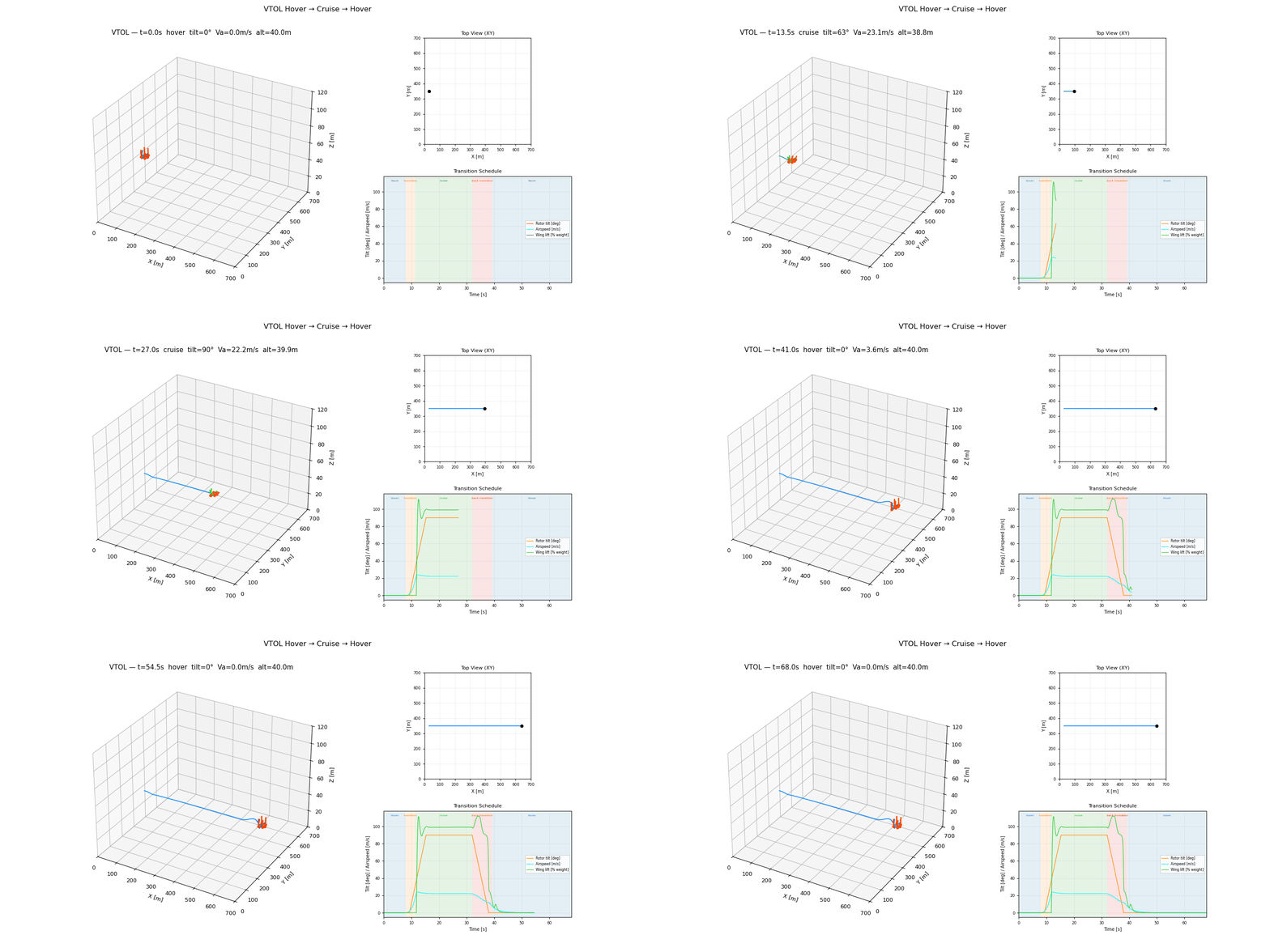
A partial tilt is not a transition. Ramping the rotors to 30° never leaves rotor-borne flight: the wing is along for the ride and the demo is a slow quadrotor. The interesting regime is the handover itself, which only happens when the rotors go the full 90° and lift authority actually migrates to the wing. In cruise here the wing carries 95 % of the weight.
Draw the tilt, don't imply it. This demo was previously rendered with a fixed-geometry quadrotor, which hid the one thing it exists to show: the rotors rotating through 90°. It now uses
draw_vtol_3d, whose nacelles sit at the aircraft's actual tilt angle, so hover, transition and cruise are distinguishable from the picture alone.Let the mode machine own the schedule.
VTOLControllerswitches on measured airspeed against the wing's stall margin, so the tilt ramp is a consequence of the aircraft being ready rather than an open-loop timer that happens to work at one set of conditions.Watch altitude through the transition, not just at the ends. That is where a single altitude law has to degrade gracefully from pure rotor lift to pure wing lift; the atlas demo holds it to 4.8 m peak deviation.
Transition corridors need explicit safety constraints.
Inadequate gain scheduling causes pitch excursions and altitude loss.
Propulsion and control-surface limits must be jointly managed.
Evidence
References
- Lustosa et al., Dynamic Transition for VTOL UAVs
- Sun et al., Review of Tilt-Rotor and VTOL Transition Control