
Resilient Mesh
Problem Statement
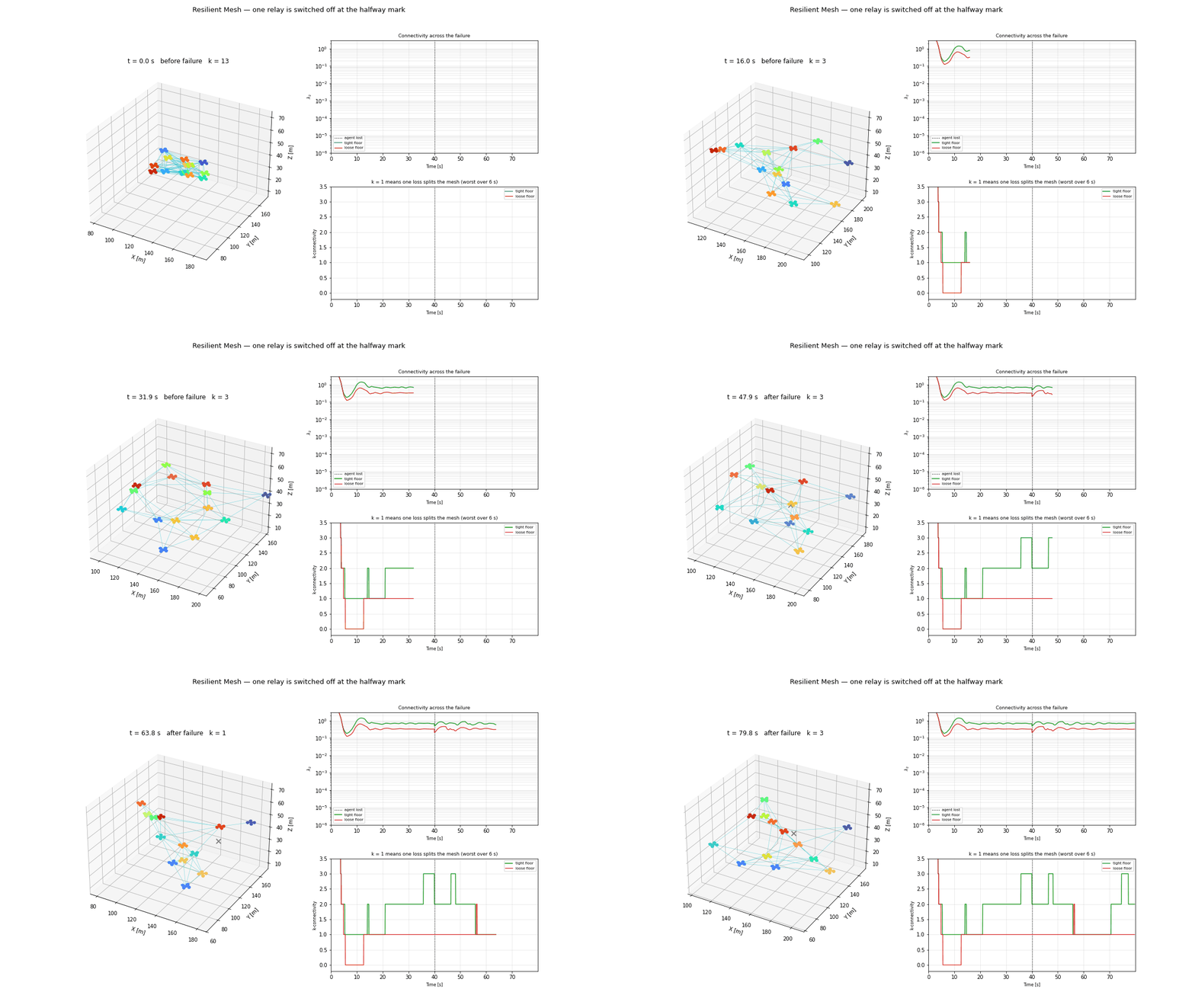
A connected network is not a survivable one. A chain has healthy algebraic connectivity right up until any single agent in it fails, at which point it is two networks. At the halfway mark the agent whose removal costs the most connectivity — the adversarial choice, not a random one — is switched off.
Model and Formulation
degree_of_connectivity measures survivability directly, by brute-force removal rather than a spectral proxy:
Tuning and Failure Modes
- k and λ₂ answer different questions. k is computed on the thresholded graph, λ₂ on the weighted one. A Gaussian link never reaches exactly zero, so λ₂ stays strictly positive even for a fleet with no usable links — it merely becomes very small.
- The threshold matters more than it looks. At 0.25 a link here needs 50 m while the median pair sits 70 m apart, which reports a disconnected mesh that is in fact doing fine. At 0.10 the same fleet is k = 3.
- Fail the right agent. A random failure mostly picks one nobody depended on, which proves nothing.
Evidence
| fleet | worst k before → after | λ₂ after |
|---|---|---|
| tight floor (0.55) | 3 → 2 | 0.688 |
| loose floor (0.24) | 1 → 1 | 0.323 |
Neither fleet splits. The tight fleet keeps k ≥ 2 throughout, so it still survives any single further loss; the loose fleet was a single point of failure before the loss and remains one. Redundancy is the thing being measured, and it is not the same question as "is the network up".
k is reported as the worst value over a trailing six seconds, matching the plot. It is an integer that flips as agents drift across the link threshold, so an instantaneous sample flatters whichever moment it lands on.
References
- Fiedler, Algebraic connectivity of graphs (1973)
- Sabattini et al., Decentralized connectivity maintenance (2013)