
Voronoi Coverage (Lloyd's Algorithm)
Problem Statement
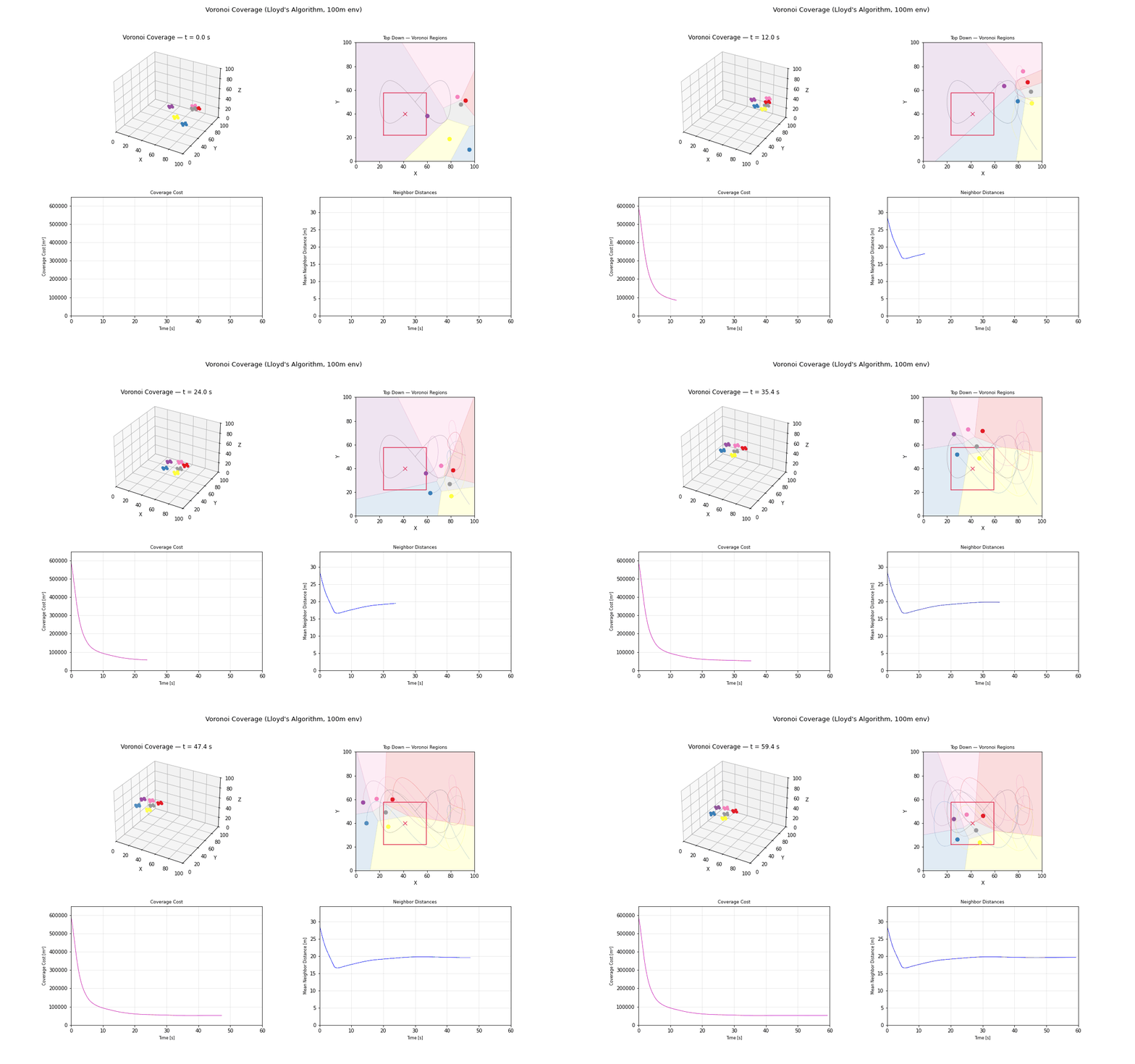
Coverage control places agents to minimize sensing distance over an area. Voronoi partitioning with Lloyd descent yields distributed, geometrically interpretable coverage behavior.
Model and Formulation
Coverage objective:
where V_i is the Voronoi cell of agent i. Lloyd update moves each agent to its cell centroid.
Practical Notes
The integration grid is the algorithm.
CoverageControllertakes bounds as[[x_min, y_min], [x_max, y_max]]; transposing those corners builds an empty grid, so every Voronoi cell is empty, every centroid equals its own agent, and every force is exactly zero. The agents sit still and the cost plot is flat — a silent no-op that looks like convergence. The constructor now rejects the transposed form rather than accepting it.Measure convergence with the locational cost
H(P), the quantity Lloyd actually descends, not the norm of the residual force. Residual force says how far the last step moved; it says nothing about whether the configuration is any good.The region travels. Lloyd on a static box converges once and then has nothing left to do. Here a fixed-size region tracks the swarm figure-8, so coverage becomes a continuous problem and the team keeps redistributing itself as its ground slides away.
recentertranslates the precomputed integration grid rather than rebuilding it: re-meshing every step would dominate runtime for a result identical to a vector add, and it would change the grid point count whenever the new bounds missed a multiple ofresolution, making the cost jump for reasons unrelated to the agents.An agent outside the region is stranded, not merely idle. Its Voronoi cell contains no grid points, so Lloyd hands back a centroid equal to its own position and the force is exactly zero — it never returns. This never arises while the region covers the whole workspace, because every agent always owns some of it; with a travelling region agents fall outside constantly.
compute_forcesrecalls them, andrecall_outside=Falsekeeps textbook-pure Lloyd available for comparison.Feed the region's velocity forward. The coverage force only ever points at where the region is now, so without it the team spends the whole run chasing and never settles inside. With it the cost falls monotonically and stays down while the region moves.
Convergence depends on bounded domain and update damping.
Density
\phi(q)can bias coverage toward high-priority regions.Voronoi recomputation cost grows with agent count.
Implementation and Execution
python -m flybots.simulations.swarm.voronoi_coverageEvidence
References
- Cortes et al., Coverage Control for Mobile Sensing Networks (2004)
- Bullo et al., Distributed Control of Robotic Networks