
Multirotor Mixer
Problem Statement
A hard-coded 4×4 mixing matrix describes exactly one airframe. Given rotor positions and spin directions, the same matrix can be derived for any layout — and the quadrotor falls out of it as the four-rotor case.
This run flies a quadrotor, a hexacopter and a coaxial octocopter through the same closed-loop box under the same cascaded controller. Nothing above the mixer knows how many rotors are below it.
Model and Formulation
Rotor
The mixer is
The rate loop gains are scaled by each airframe's inertia so all three fly at the same closed-loop bandwidth — constant angular acceleration per unit rate error, which reproduces the library's default quadrotor gains exactly.
Practical Notes
never enters , so a coaxial pair adds thrust and yaw authority and no roll or pitch authority. The X8 has the leverage of the quadrotor it is built on. - Yaw has no lever arm: it scales with
(16 mm on the S550) against a 275 mm roll arm. The heading command is ramped rather than stepped, because a 90° step saturates every rotor before the aircraft has turned ten degrees. - The signs come from FLU, where positive pitch is nose-down. A rotor at the front produces
and the nose goes up.
Evidence
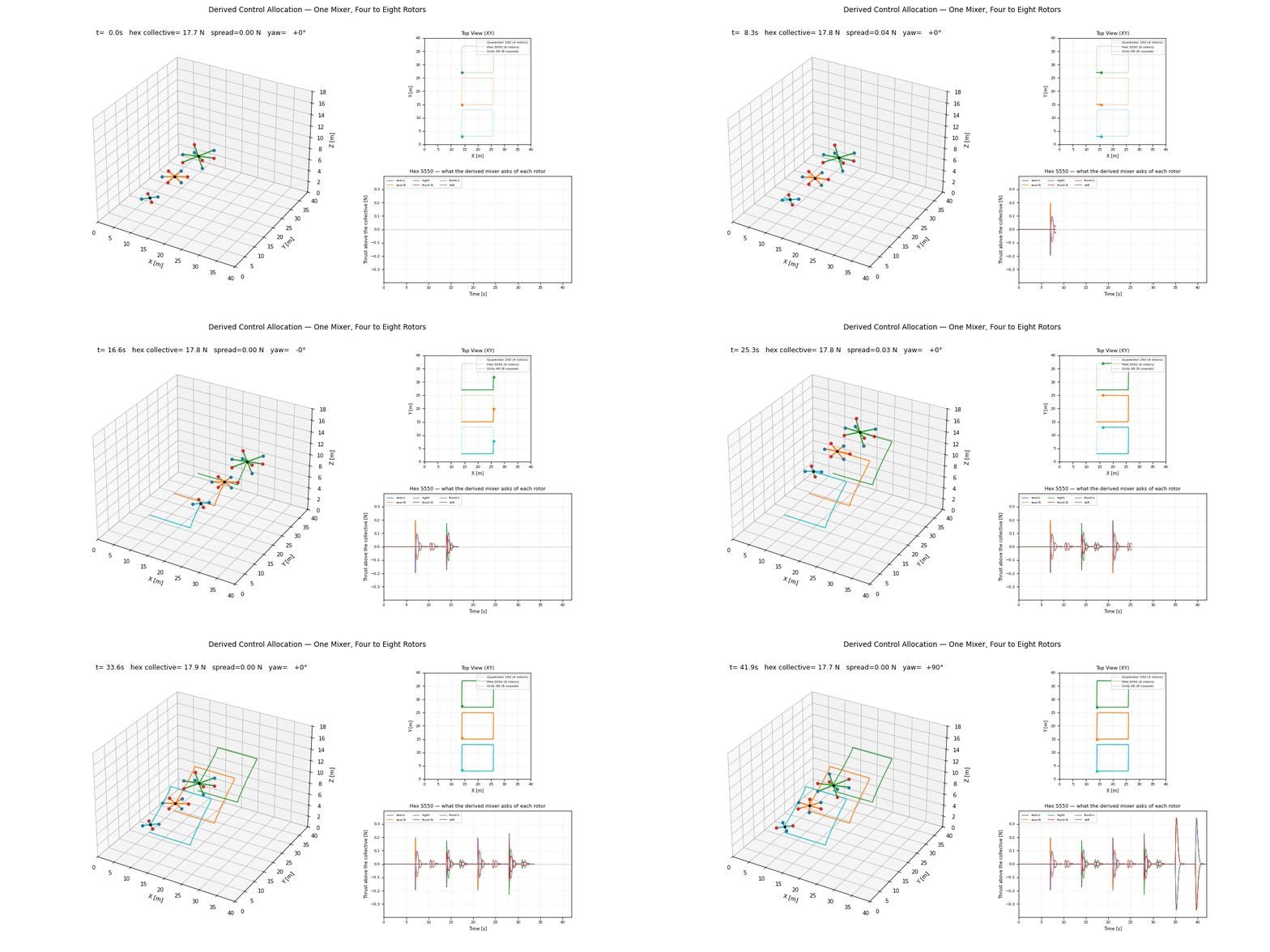
The lower panel plots each of the hexacopter's six rotor thrusts against the instantaneous collective. Hover is a flat line. The translation legs split the rotors by position. The yaw turn splits them into two groups of three by spin direction, which is where yaw authority comes from.
All three airframes hold their waypoints to about 0.34 m and reach the commanded 90° heading, with roughly 2× thrust headroom throughout.
References
- Achtelik et al., Design of a Multi Rotor MAV with regard to Efficiency, Dynamics and Redundancy (AIAA GNC 2012)
- Johansen and Fossen, Control allocation — A survey (Automatica 2013)
- Mahony, Kumar and Corke, Multirotor Aerial Vehicles (IEEE RAM 2012)