
Pure Pursuit 3D
Problem Statement
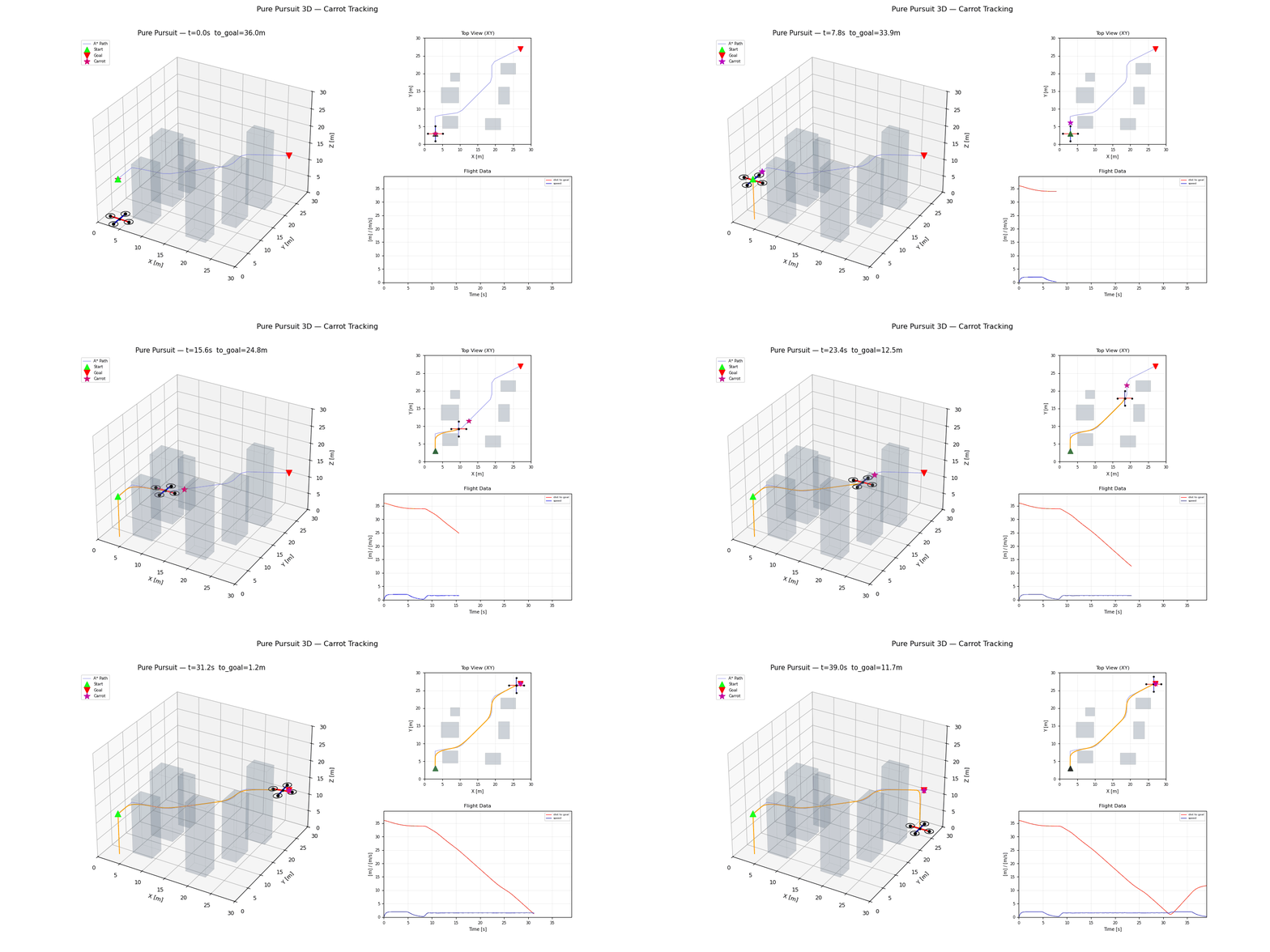
Given a waypoint list and a position controller, pure pursuit answers the only question in between: which point should the vehicle aim at right now? It chases a "carrot" a fixed distance ahead on the path, which turns a sequence of corners into a smooth, continuously-defined setpoint.
Model and Formulation
The carrot is the intersection of a sphere of radius L about the vehicle with the path:
Taking the furthest intersection on the earliest remaining segment keeps the target moving forward. With adaptive, the look-ahead grows with speed:
Making Progress Monotone
The subtle part is not finding the carrot — it is deciding which segment to search from. Advancing the index only when the vehicle comes within waypoint_threshold of the current waypoint is not enough. On a trajectory that loops back near itself, the vehicle can sit outside that threshold while the look-ahead sphere keeps intersecting an earlier segment. The carrot stays behind it, and it circles there forever. The min-snap demo used to hit its 90 s timeout 24 m short of the goal for exactly this reason.
The fix is to snap the index to the nearest waypoint ahead — but bounded, and bounded by arc length along the path, not by waypoint count:
window = self._search_window(path, self._idx)   # progress_window × lookahead
nearest = argmin(‖path[idx:window+1] - position‖)
self._idx += nearest
Why arc length: on a lawnmower coverage path, adjacent lanes pass within a metre of each other while being many metres apart along the path. An index window lets the tracker hop lanes and skip most of the coverage — 93 % down to 44 % on the occupancy-mapping demo. An arc-length window cannot, because reaching the next lane costs more path than the window allows.
Two Thresholds, Not One
waypoint_threshold decides when to advance between waypoints; goal_threshold decides when the mission is finished. They want different values. Advancing early is what keeps the path smooth; declaring the goal reached early leaves the vehicle short by exactly that slack — which is how missions came to be scored as never having arrived while flying perfectly well.
Algorithm Procedure
- Snap the segment index forward to the nearest waypoint within the arc-length window.
- Advance past any waypoint already inside
waypoint_threshold. - Scale the look-ahead with current speed.
- Intersect the look-ahead sphere with the remaining segments; take the first hit.
- Smooth the target temporally to avoid a jump at segment transitions.
Tuning Guidance
- Larger look-ahead cuts corners and smooths; smaller tracks tightly and can oscillate. It is the single most consequential parameter.
smoothingis a first-order filter on the carrot, not on the vehicle — it hides segment-transition steps without adding vehicle lag.- Set
goal_thresholdfrom the mission's success criterion, not fromwaypoint_threshold.
Failure Modes and Diagnostics
- A vehicle circling one region forever is a progress problem, not a control problem.
- Coverage paths losing lanes means the progress window is measured in indices.
- Look-ahead longer than the corner radius cuts corners into obstacles.
Implementation and Execution
python -m flybots.simulations.path_tracking.pure_pursuitEvidence
References
- Coulter, Implementation of the Pure Pursuit Path Tracking Algorithm, CMU-RI-TR-92-01 (1992)
- Snider, Automatic Steering Methods for Autonomous Automobile Path Tracking (2009)