
Reynolds Flocking
Problem Statement
Reynolds flocking produces coordinated multi-agent motion from local interaction rules, without centralized planning.
Model and Formulation
For agent i, acceleration is the weighted sum:
where separation avoids collisions, alignment matches heading, and cohesion preserves group compactness.
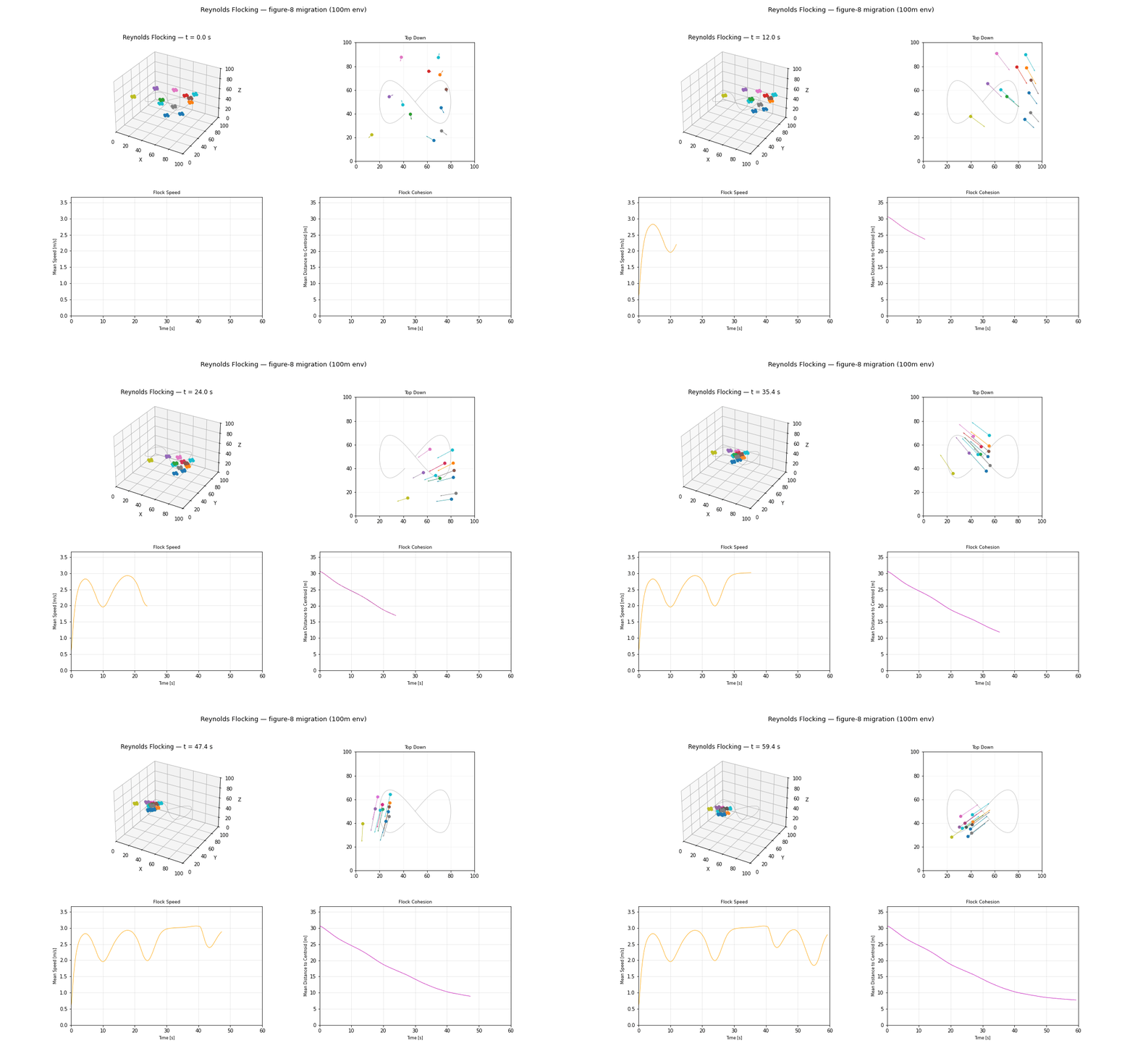
Reynolds' fourth term, the migratory urge, is what makes the flock go somewhere:
Practical Notes
- Perception radius and separation radius define local interaction topology.
- Rule weights set global behavior: tight flocking, milling, or loose travel.
- Speed clipping is essential to prevent unstable divergence.
- The three classic rules all go to zero once the flock is in formation. Separation, alignment and cohesion describe how agents arrange themselves relative to each other, not where the group goes, so with any velocity damping a flock running on those three alone coasts to a standstill and sits there — arranged correctly, going nowhere. The migratory urge is not decoration.
- Perception radius has to cover the initial spread. An agent that starts outside everyone's radius has no neighbours, and nothing in the local rules will ever bring it back.
Implementation and Execution
bash
python -m flybots.simulations.swarm.reynolds_flockingEvidence
References
- Reynolds, Flocks, Herds, and Schools (1987)
- Olfati-Saber, Flocking for Multi-Agent Dynamic Systems (2006)