
LQR Path Tracking
Problem Statement
LQR hover stabilises a fixed point. Path tracking asks the same optimal feedback to follow a moving reference — which is not the problem LQR solves, and the gap between the two is where most of the tracking error comes from.
Model and Formulation
The gain comes from the same hover linearisation and Riccati solution:
An LQR Is a Regulator
This matters more than the weighting matrices. LQR drives the error to zero only for references the model can hold with the equilibrium input. A constant-velocity reference qualifies — ẋ_ref = A x_ref holds when the velocity rows are already in A. An accelerating reference does not: nothing in u_hover produces p̈_ref, so the loop has to generate that acceleration out of error alone, and settles at whatever standing error does the job.
The fix is the quadrotor's differential flatness written out. From the hover linearisation, v̇x = gθ and v̇y = -gφ, so the attitude and thrust that produce a commanded acceleration follow in closed form:
Pass them through feedforward_acc and the regulator only has to correct the residual:
target = np.zeros(12)
target[:3], target[6:9] = ref_pos, ref_vel
wrench = lqr.compute(state, target, feedforward_acc=ref_acc)
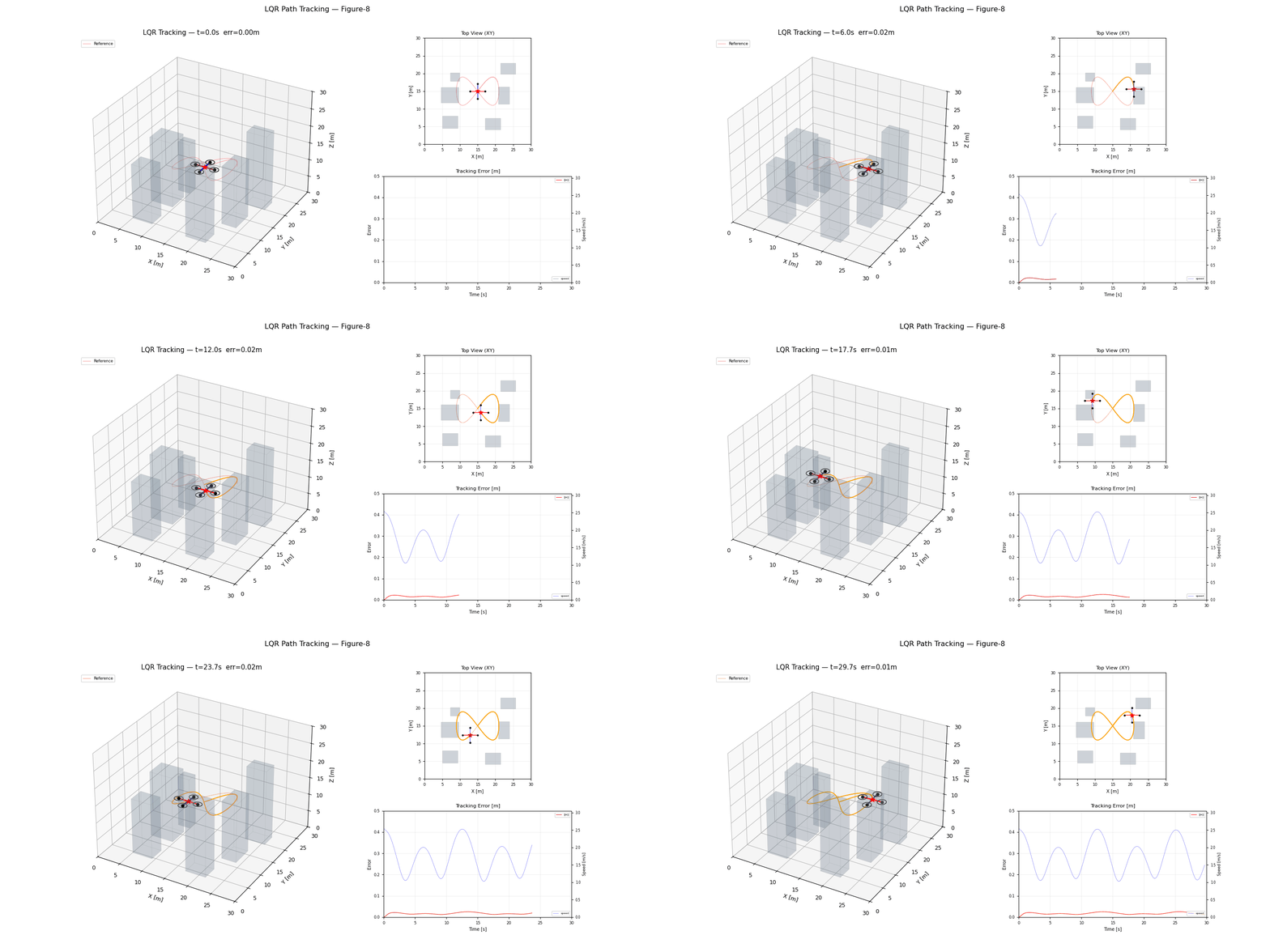
On the atlas figure-8 that is the difference between 0.158 m mean error with a 4.6 % amplitude overshoot and 0.017 m with none.
Algorithm Procedure
- Linearise about hover and solve the continuous-time Riccati equation once, offline.
- Each step, build the reference state from the trajectory's position and velocity.
- Convert the reference acceleration into feed-forward attitude and thrust.
- Apply
u = u_hover + u_ff - K(x - x_ref).
Tuning Guidance
QandRset the regulator's disturbance rejection, not its ability to follow a trajectory. If tracking error scales with reference speed, the missing piece is feed-forward, not gain.- Re-linearise if the trajectory demands attitudes far from hover.
- The gain is computed once at construction; the Riccati solve is not in the loop.
Failure Modes and Diagnostics
- Error proportional to reference velocity or acceleration means missing feed-forward.
- Aggressive trajectories violate the small-angle linearisation; the geometric controller has no such limit.
- Badly scaled
Q/Runits produce gains that look reasonable and behave strangely.
Implementation and Execution
python -m flybots.simulations.path_tracking.lqr_trackingEvidence
References
- Anderson and Moore, Optimal Control: Linear Quadratic Methods
- Mellinger and Kumar, Minimum Snap Trajectory Generation and Control for Quadrotors (2011)