
Frenet Optimal Trajectory
Problem Statement
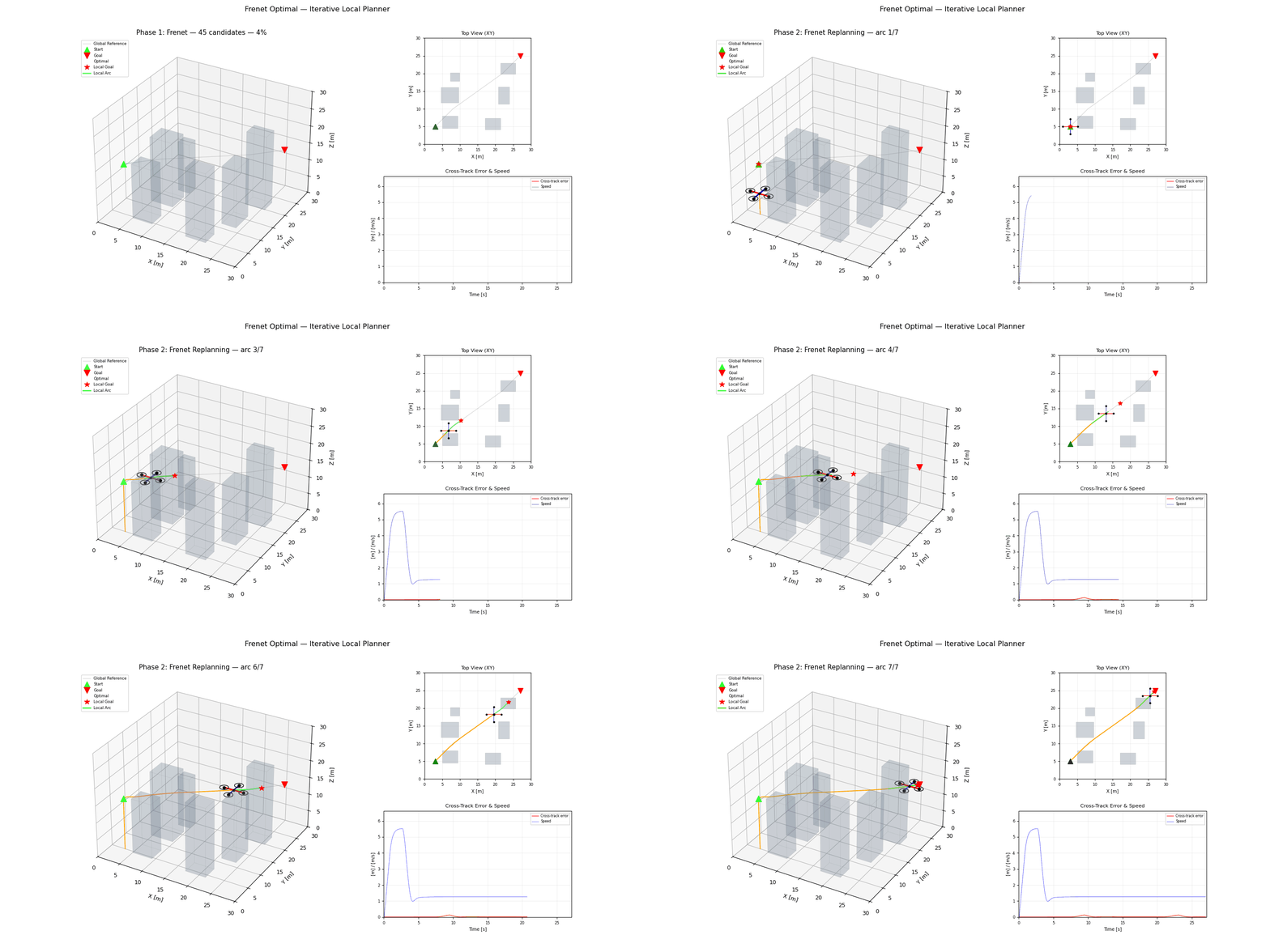
In corridor-like navigation, curvilinear coordinates simplify trajectory generation relative to a reference path. Frenet planning separates longitudinal and lateral behavior, enabling efficient candidate generation and selection.
Model and Formulation
State in Frenet frame:
Candidates are built from polynomial models:
- longitudinal
s(t)via quartic/quintic forms - lateral
d(t)via quintic forms
Total cost aggregates smoothness, offset, speed-tracking, and collision penalties:
Algorithm Procedure
- Generate candidate lateral and longitudinal profiles.
- Transform each candidate back to Cartesian coordinates.
- Evaluate dynamic, collision, and comfort constraints.
- Select minimum-cost feasible trajectory.
Tuning Guidance
- Increase collision term when operating near dense obstacles.
- Penalize lateral offset more heavily for narrow corridors.
- Short horizons improve responsiveness but can increase myopic behavior.
Failure Modes and Diagnostics
- Poor reference-path quality leads to unstable Frenet projections.
- Candidate set too small misses globally better maneuvers.
- Fast curvature changes can violate dynamic feasibility.
Implementation and Execution
bash
python -m flybots.simulations.trajectory_planning.frenet_optimalEvidence
References
- Werling et al., Optimal Trajectory Generation for Dynamic Street Scenarios in a Frenet Frame (2010)
- Bender et al., The Urban Challenge: Integrating Planning and Control