
Potential-Based Swarm
Problem Statement
Potential-field swarm control combines attractive and repulsive fields to produce distributed collision-avoiding collective motion.
Model and Formulation
Agent force model:
where U_{ij} can be Lennard-Jones-like or quadratic barrier potentials.
Practical Notes
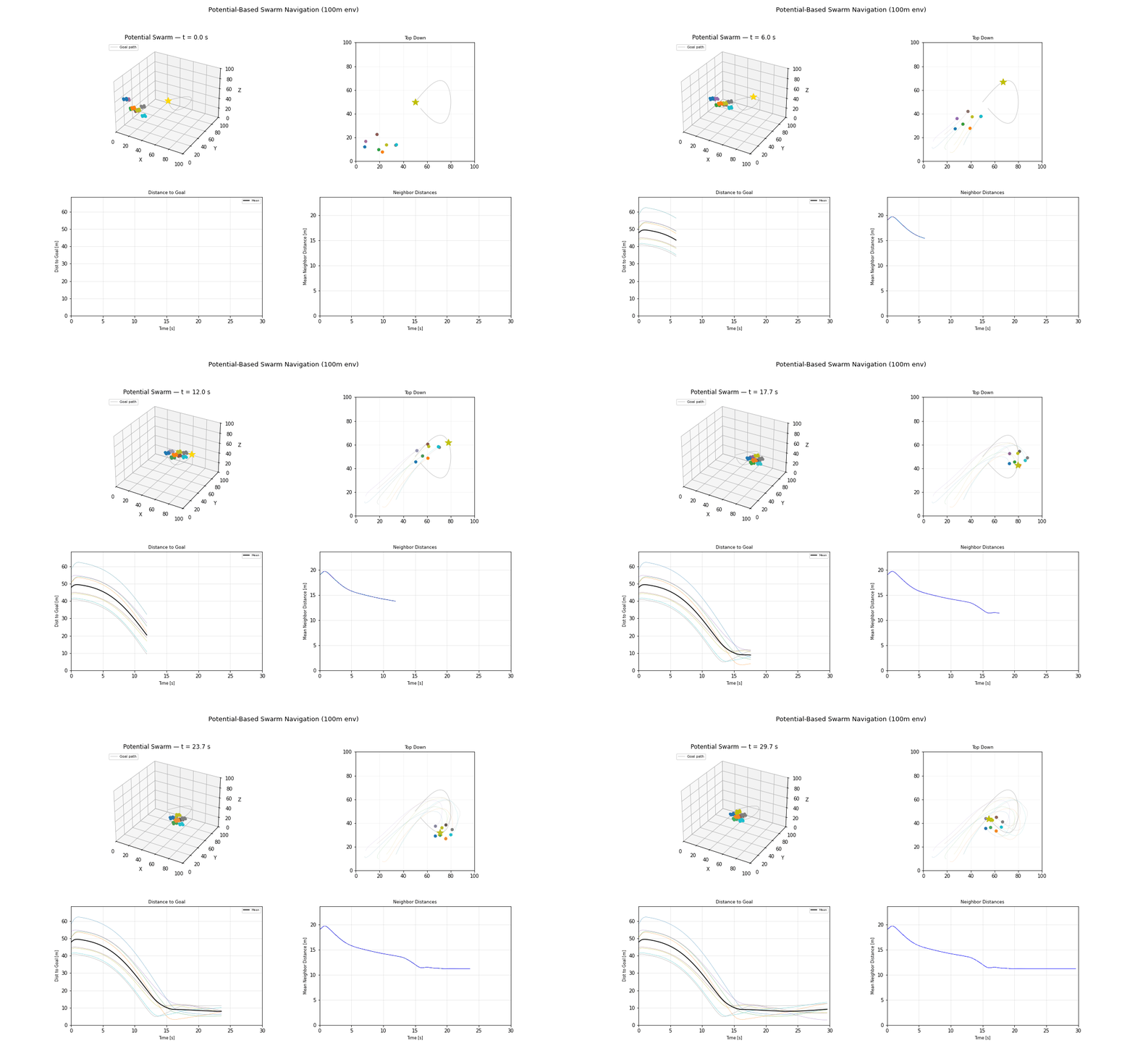
Saturate the goal attraction. Unsaturated linear attraction is thousands of times stronger than the lattice forces at the start of a long transit, so the swarm crosses the map as a disordered blob and only forms up on arrival. Capping it at a fixed radius keeps formation-keeping and navigation comparable throughout.
Clamp the obstacle repulsion. The
1/d²term is unbounded, so an agent that clips an obstacle receives an infinite kick and leaves the world. Floor the surface distance and cap the total force.Score the centroid, not the agents. A lattice converges with each agent one spacing away from the goal by construction, so mean agent-to-goal distance never goes to zero and reads like a failure. The meaningful numbers are centroid-to-goal error and nearest-neighbour spacing against
d_des.Potential shape determines spacing and rigidity.
Local minima are a known issue in cluttered environments.
Add damping terms to prevent oscillatory interactions.
Implementation and Execution
python -m flybots.simulations.swarm.potential_swarmEvidence
References
- Spears et al., Distributed Physics-Based Control of Swarms (2004)
- Khatib, Real-Time Obstacle Avoidance for Manipulators and Mobile Robots (1986)