
Path Smoothing
Problem Statement
Grid and sampling planners return paths that are correct but not flyable: A* output steps between cell centres, RRT output zigzags between random samples. Smoothing sits between the planner and the tracker, turning a collision-free polyline into something a vehicle with inertia can follow without stopping at every vertex.
Model and Formulation
Two stages, in order.
Ramer–Douglas–Peucker removes vertices that carry no shape. For the segment from p_start to p_end, find the point with the greatest perpendicular distance:
Keep it and recurse if d_max > ε; otherwise discard everything between the endpoints.
Cubic-spline resampling then places points at uniform arc length along a C² interpolant of what survives, so curvature is continuous and the tracker's look-ahead sphere always finds a clean intersection.
Why Both, and in That Order
Splining the raw path directly fits the planner's discretisation noise — every grid step becomes a wiggle the vehicle then flies. RDP first removes the noise; the spline then only has to round the corners that carry real shape. Running them the other way round, or skipping RDP, produces a smooth path that is longer and busier than the one A* found.
RDP is also what keeps the corners legal. It only ever removes points, never moves them, so a simplified path stays inside the corridor its epsilon allows. The spline does move points, which is why ε and the inflation radius have to be chosen together.
Algorithm Procedure
- Plan a raw path (A*, RRT*, PRM).
- Simplify with RDP at a tolerance smaller than the obstacle inflation.
- Resample the survivors along a cubic spline at fixed spacing.
- Verify clearance on the resampled path before flying it — the spline may cut a corner RDP preserved.
- Hand the result to pure pursuit.
Tuning Guidance
epsilonis the shape budget: too small keeps the zigzags, too large cuts corners into obstacles. Keep it well under the inflation radius used during planning.- Resample spacing should be a fraction of the tracker's look-ahead, so the sphere intersection is never ambiguous.
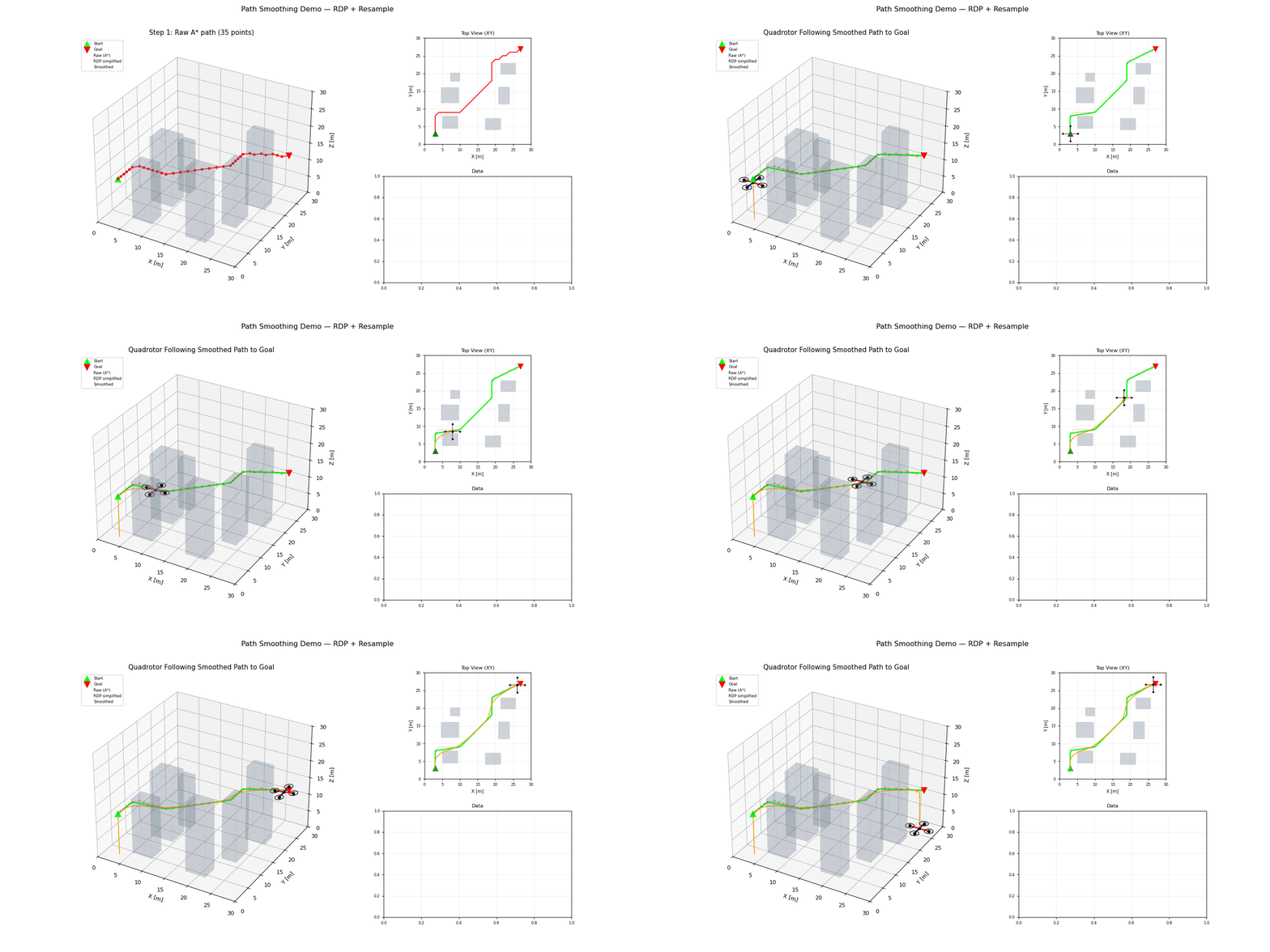
- Smoothing shortens paths. The atlas A* demo goes from 37.7 m raw to 35.8 m smoothed.
Failure Modes and Diagnostics
- A spline through sparse waypoints can bulge outside the corridor between them; always re-check clearance after resampling, not just after RDP.
- Duplicate or near-duplicate waypoints make the spline parameterisation ill-conditioned.
- Over-aggressive simplification is easiest to spot as a path that clips an obstacle corner the raw path respected.
Implementation and Execution
python -m flybots.simulations.path_tracking.path_smoothing_demoEvidence
References
- Douglas and Peucker, Algorithms for the Reduction of the Number of Points Required to Represent a Digitized Line (1973)
- Ramer, An Iterative Procedure for the Polygonal Approximation of Plane Curves (1972)