
Position Exchange (CBF safety filter)
Problem Statement
Eight agents sit on a ring, each commanded straight at the point diametrically opposite it. Every straight-line path crosses the centre at the same moment, so the nominal controller — a plain PD that cannot see the other agents — drives the fleet into a single point.
A control barrier function filter sits between that controller and the vehicles. It plans nothing. It edits the command only when a pair is about to close inside the safe distance, and only by as much as it must.
Model and Formulation
The safe set is
The squared form is used rather than
Relative degree is the thing to get right. The input is acceleration, so
Each barrier contributes rows to one fleet-wide program:
Solved as a least-distance program through its non-negative least-squares dual, which terminates exactly in finitely many steps. Inside a control loop that matters: a solver that merely usually converges is not a safety guarantee.
Tuning and Failure Modes
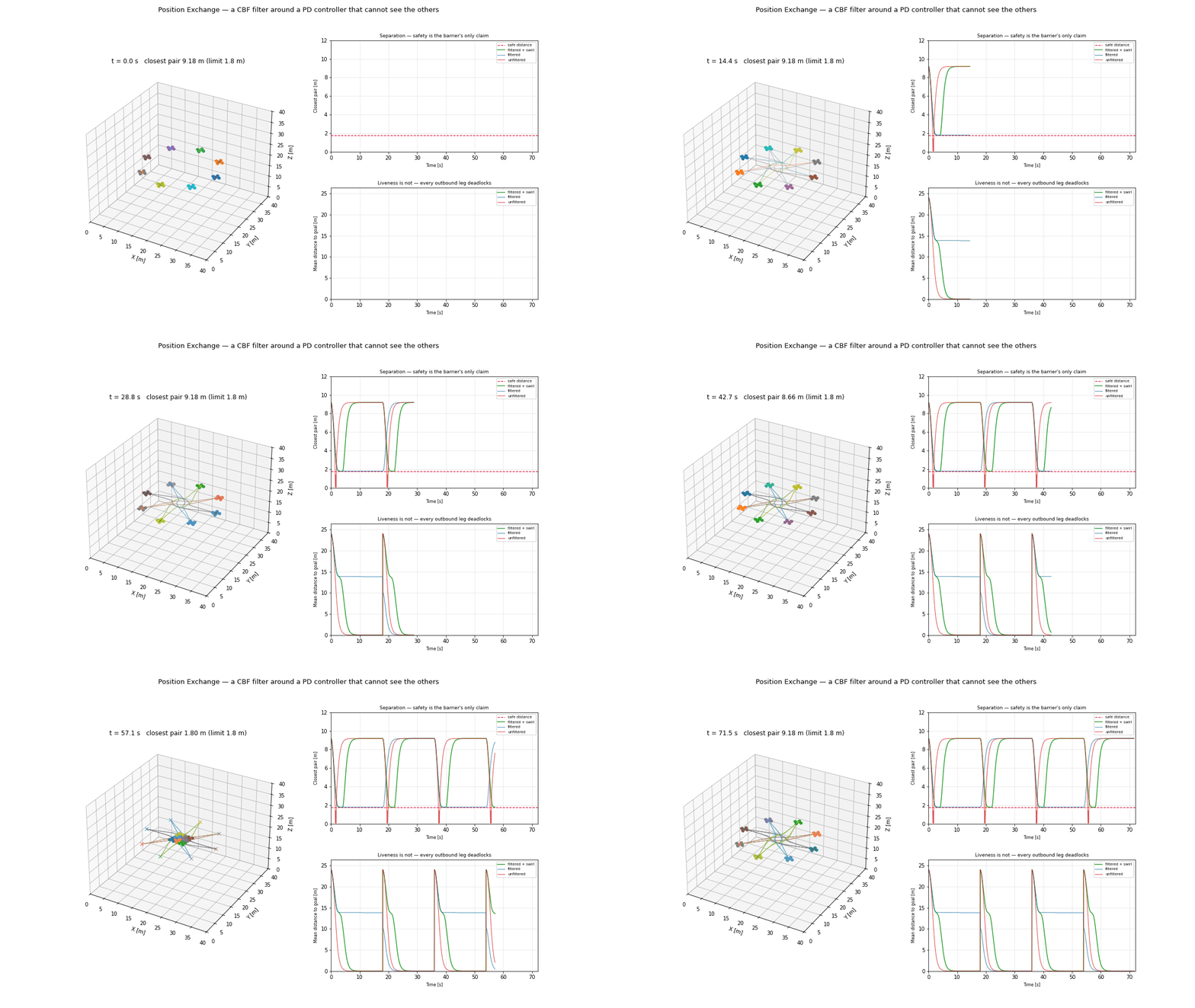
- A CBF guarantees safety, not liveness. Standing still satisfies every barrier, so the QP will hold a symmetric fleet still indefinitely. Here eight agents pressed evenly against each other deadlock 13.9 m from their goals, perfectly safely. A tangential bias, faded in only while the fleet is jammed, breaks the symmetry and the swap completes; a constant swirl instead drags every agent off its goal for the whole run.
- Solve one program for the whole fleet, not one per agent. A pairwise constraint couples both agents' accelerations, so a single QP splits the avoidance effort between them. Per-agent programs make each assume the other will not move, and both then dodge the same way.
- Discretisation eats into the margin. The condition holds in continuous time; a forward-Euler step lets it overshoot, and the runs here settle 0.6–0.9 % inside the barrier. Size the safe distance with room for that rather than trusting the number exactly.
- Enter actuator limits as constraints, not as a clip. Clipping a solved command can walk it straight back through a barrier the QP had just satisfied.
- Infeasibility is a real outcome. Ask for a separation larger than the communication range and no input satisfies both. The filter reports it rather than silently returning something unsafe.
Implementation and Execution
python -m flybots.simulations.safety.position_exchangeEvidence
| run | closest pair | worst leg error |
|---|---|---|
| unfiltered | 0.051 m | 0.000 m |
| filtered | 1.799 m | 13.803 m |
| filtered + swirl | 1.784 m | 0.000 m |
Safe distance 1.800 m. The unfiltered run reaches every goal and passes through itself to do it; the filtered run never violates the barrier.
The fleet swaps, swaps back, and repeats, so the crossing — the only part worth watching — recurs through the whole run instead of finishing in five seconds and leaving forty of frozen ring. That also turns the deadlock from an anecdote into a pattern: without the swirl the outbound leg jams every single time, while the return leg always completes, because returning is the direction the jam does not block. The figure quoted is therefore the worst leg, not the last sample — the run ends on a return leg, which hides it.
References
- Ames et al., Control Barrier Function Based Quadratic Programs for Safety Critical Systems (2017)
- Xiao and Belta, High Order Control Barrier Functions (2022)
- Borrmann et al., Control Barrier Certificates for Safe Swarm Behavior (2015)