
Geometric Control on SE(3)
Problem Statement
Euler-angle controllers carry singularities and lose meaning at large attitudes. Geometric control works directly on the rotation group SO(3), so the attitude error is well defined everywhere and the same law covers gentle hover and aggressive flight.
Model and Formulation
Position control produces a desired force vector:
Thrust is its projection onto the current body z-axis, and the desired attitude is built from F_d:
The attitude error lives in the Lie algebra:
Algorithm Procedure
- Form position and velocity errors against the reference.
- Build the desired force, adding the reference acceleration as feed-forward.
- Extract thrust and the desired rotation
R_dfrom that force. - Differentiate
R_dto recover the desired angular velocityΩ_d. - Compute the
SO(3)attitude error and the resulting torque.
Two Terms That Are Easy to Drop
Both feed-forward terms are optional in the sense that the code runs without them, and both change the character of the controller when they are missing.
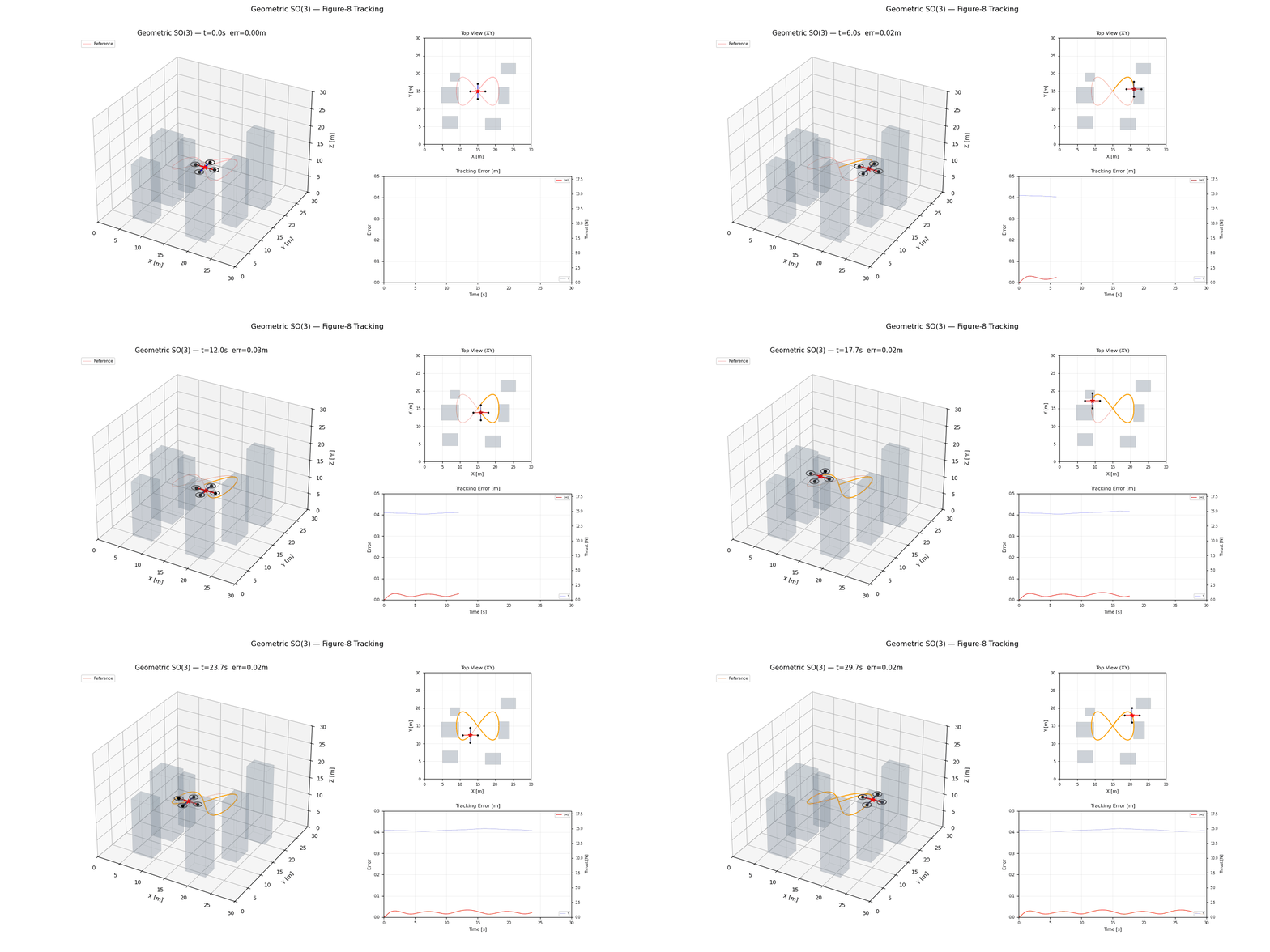
Reference acceleration. Without it the error dynamics are driven by p̈_ref itself, so the tracking error is whatever the second-order error system does when forced at the trajectory's own frequency. On the atlas figure-8 that was a 17 % overshoot on the fast axis and 0.39 m mean error; adding it takes the same controller to 0.023 m.
Desired angular velocity. Ω_d is not zero on a moving trajectory — R_d rotates as the required force vector swings around. Assuming Ω_d = 0 asks the attitude loop to fight its own reference. The implementation recovers it by differentiating R_d: Ω̂_d ≈ R_d(k-1)^\top \dot{R}_d.
Tuning Guidance
Gains here are derived from the inertia, not typed in:
- A gain that suits one airframe is wrong for another by the ratio of their inertias — the controller commands a torque, not an acceleration.
- Keep the attitude bandwidth several times the position bandwidth. If the two are comparable they resonate, and the quadrotor overshoots every turn of the reference. The default is 8×.
max_accbounds the horizontal acceleration, and therefore the commanded tilt.
Failure Modes and Diagnostics
- Comparable position and attitude bandwidths produce a lightly damped overshoot that looks like a tuning problem but is a loop-separation problem.
F_dnear zero makesb_3dill-conditioned; the implementation floors the norm.- A desired yaw parallel to
b_3ddegenerates theb_2dcross product.
Implementation and Execution
python -m flybots.simulations.path_tracking.geometric_controlEvidence
Mean tracking error on the standard figure-8: 0.023 m, peak 0.034 m, with the flown amplitude matching the reference to within 0.3 %.
References
- Lee, Leok, McClamroch, Geometric Tracking Control of a Quadrotor UAV on SE(3) (2010)
- Bullo and Lewis, Geometric Control of Mechanical Systems