
Visual Servoing — Gimbal Camera
Problem Statement
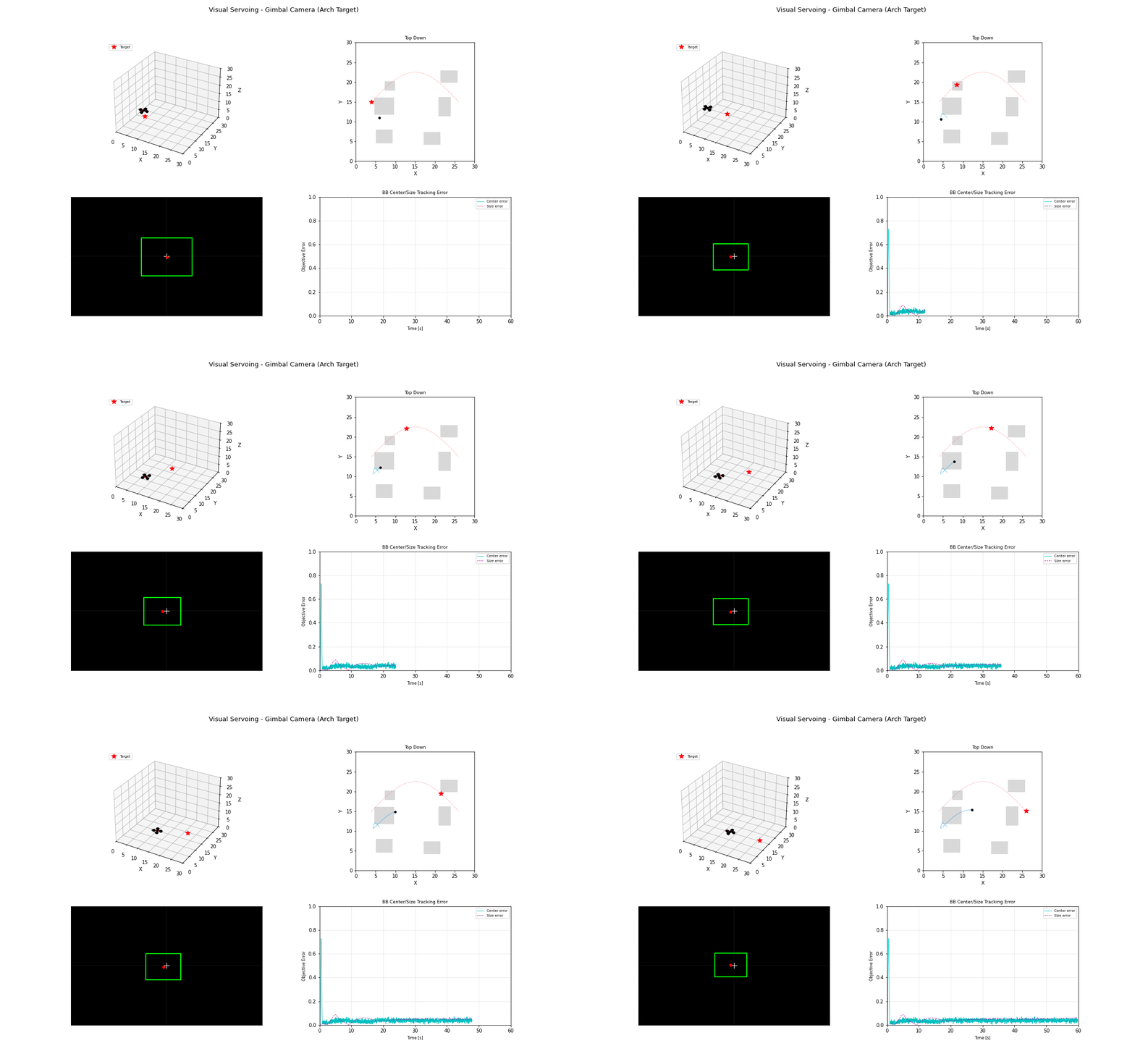
Image-based visual servoing (IBVS) with a pan-tilt gimbal. The gimbal owns the fast loop — it keeps the bounding box centred — and the drone owns the slow loop: it flies so the gimbal stays near its neutral pointing angle and the target keeps its desired apparent size.
That split is the whole point of the demo. Once a gimbal is in the loop, centring the bounding box no longer tells the drone where to go, because the gimbal absorbs the error before the airframe ever sees it. A controller ported straight from the fixed-camera case will sit still and think it is tracking perfectly.
Model and Formulation
The position command is rebuilt from the gimbal angles plus the size error:
| Measurement | Actuated by |
|---|---|
| gimbal pan away from neutral | body-lateral velocity |
| gimbal tilt away from neutral | climb rate |
| bbox size error | body-forward velocity |
with the commanded velocity rotated into the world frame by the drone heading. Non-zero pan means the target has drifted off the nose; a tilt steeper than nominal means the drone is too high.
Algorithm Procedure
- Gimbal servos pan and tilt to centre the bounding box (fast loop).
- Read the gimbal angles as the drone's position error signal.
- Convert pan to lateral velocity and tilt deviation to climb rate.
- Close range on apparent size.
- Slew heading toward the target bearing at a bounded rate.
Tuning and Failure Modes
- Do not close yaw through the gimbal's own pointing loop. Commanding
yaw = yaw + panputs two pointing loops in series chasing each other. The heading winds up and drags the position controller — which resolves tilt through yaw — with it. Slew the airframe toward the target bearing at a bounded rate instead, and let the gimbal own the fast loop. - Separate the timescales deliberately. The gimbal loop must be clearly faster than the airframe loop. When the two run at comparable bandwidth they fight, and the gimbal angle stops being a clean error signal.
- Neutral tilt is a tuning parameter, not a constant.
sets the standoff geometry: too shallow and the drone creeps onto the target, too steep and it climbs away from it. - Gain
too high produces oscillatory motion that the gimbal dutifully cancels, hiding the instability from the image right up until it diverges. - Occlusion leaves the gimbal pointing at empty space, and the drone will fly to hold that pointing angle unless tracking loss is handled explicitly.
Implementation and Execution
python -m flybots.simulations.perception.visual_servoing_gimbalEvidence
References
- Chaumette and Hutchinson, Visual Servo Control Part I (2006)
- Chaumette and Hutchinson, Visual Servo Control Part II (2007)