
Connectivity Annulus
Problem Statement
Two barriers that pull opposite ways. SafeDistanceBarrier pushes every pair apart; ConnectivityBarrier pulls every pair together. Run them at once and the fleet is squeezed into a shell — close enough to talk, far enough not to touch — without anything having planned that shape. It falls out of the intersection of two safe sets.
Model and Formulation
Tuning and Failure Modes
- Start inside the safe set. A CBF guarantees forward invariance: it holds a set you are already in and cannot undo a violated initial condition. Seeding at random put three pairs inside the safe distance at t = 0, and the run then reported that as its minimum — which reads as a barrier failure when it is nothing of the kind.
- Size the initial ring against both bounds. On a circle of radius
with agents the closest pair is and the furthest is . Sizing off the separation alone put diametric pairs at 28 m against a 26 m radio: satisfying one barrier by breaking the other. - Infeasibility is a real outcome. Ask for more separation than the range allows and no input satisfies both.
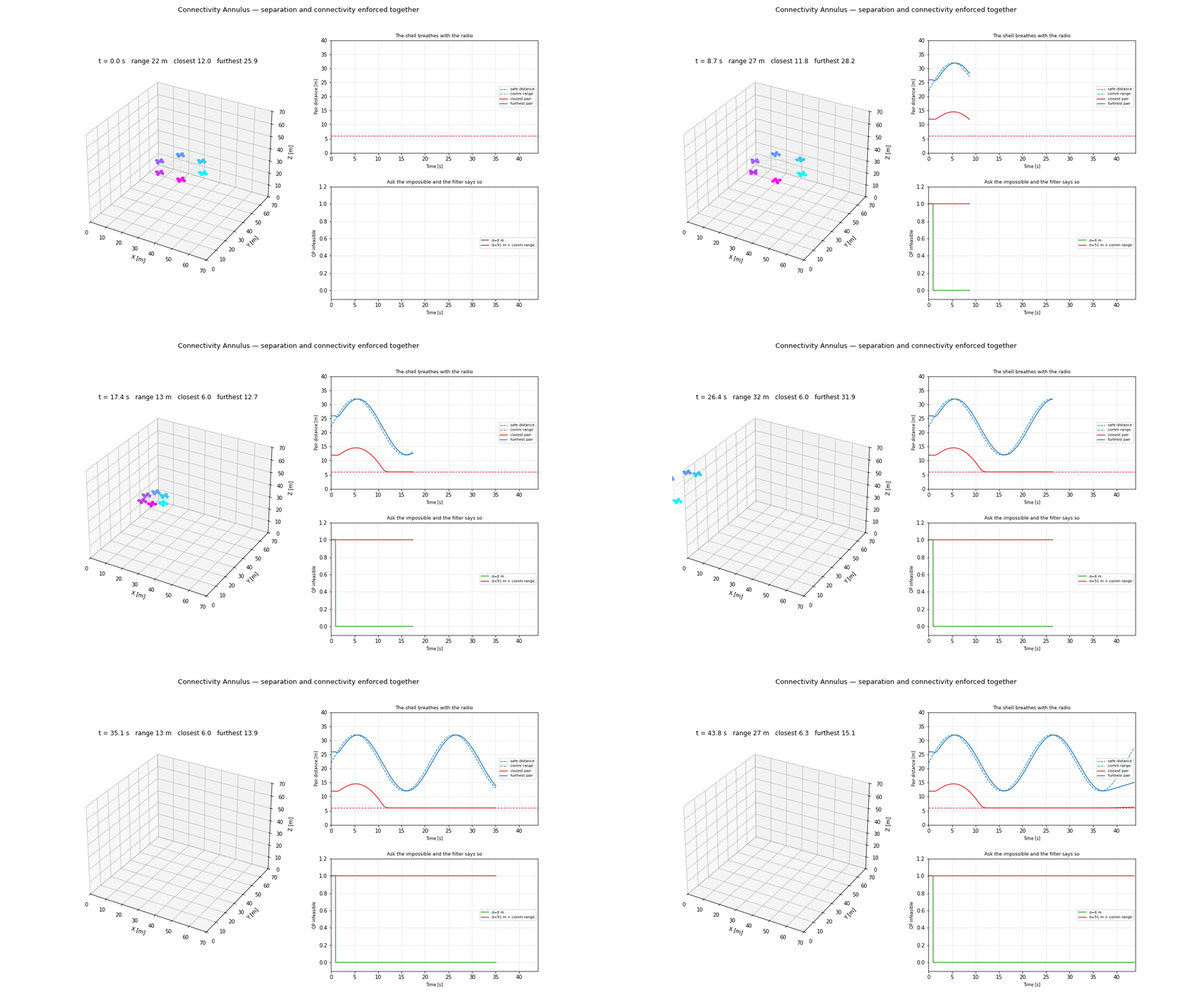
- A static scene proves nothing. Pushing outward against a fixed range reaches equilibrium in about thirteen seconds and then nothing moves. Flying the formation along a figure-8 instead put it in motion but pulled it together: the guide attraction beat the outward push, the furthest pair collapsed to half the range, and the connectivity barrier stopped being active at all — the shell, the entire point, quietly disappeared. Varying the range rather than the position keeps both barriers working.
Evidence
| quantity | value | limit |
|---|---|---|
| closest pair | 6.00 m | safe distance 6.0 m |
| furthest pair | 31.94 m | comm range 32.0 m (peak) |
The radio range breathes between 12 m and 32 m and the shell breathes with it: the fleet expands to fill whatever range it is given and contracts as that range collapses, never once closing inside the safe distance. Nothing schedules that — the barrier is simply time-varying and the QP re-solves against it each step.
The impossible case reports infeasible on 2200/2200 steps rather than returning something unsafe.
References
- Ames et al., CBF-based Quadratic Programs (2017)
- Borrmann et al., Control Barrier Certificates for Safe Swarm Behavior (2015)