
Nonlinear Model Predictive Control (NMPC)
Problem Statement
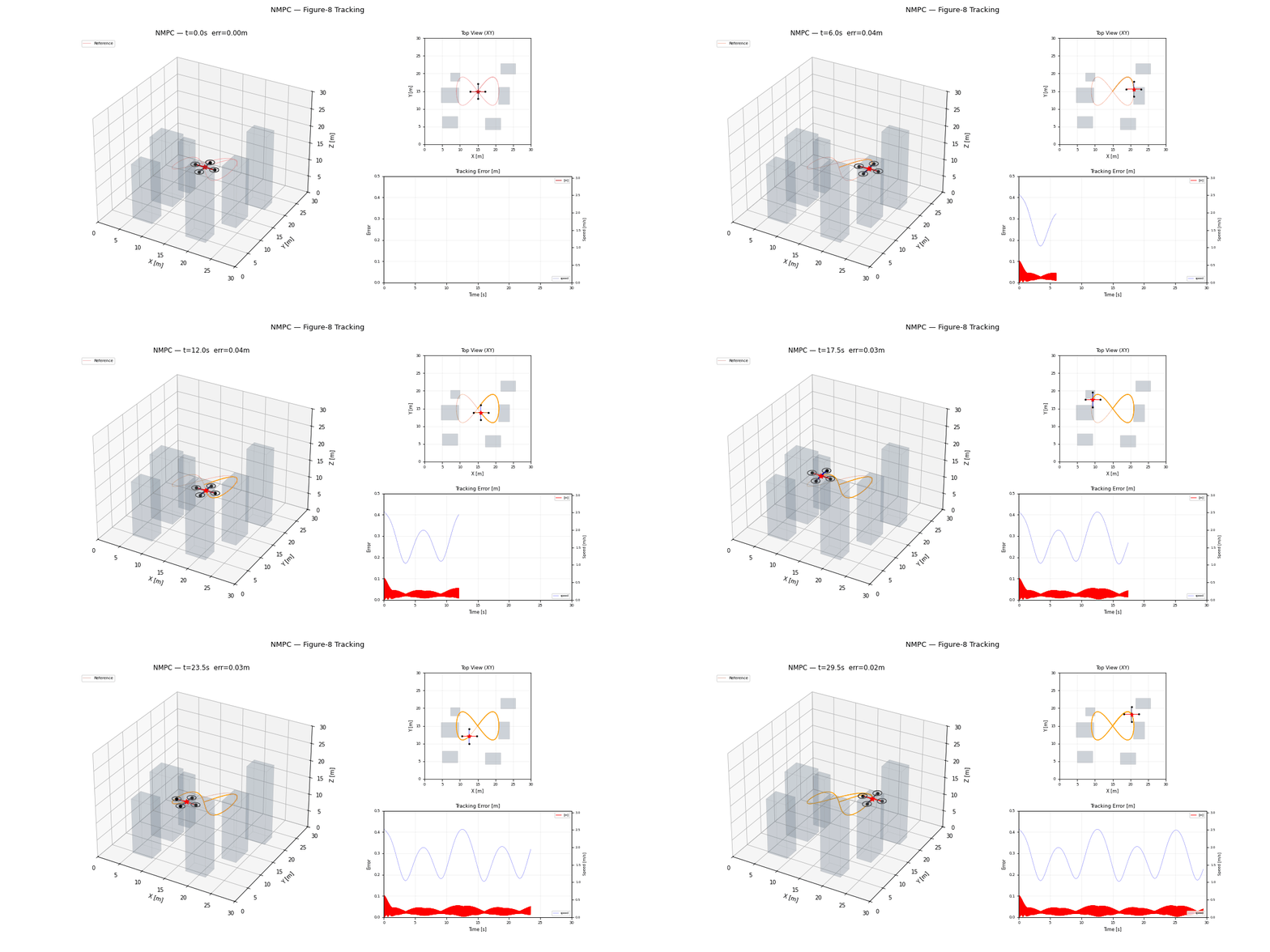
NMPC optimizes constrained control over a finite horizon using the full nonlinear UAV model. It handles state and input constraints explicitly while tracking aggressive trajectories.
Model and Formulation
At each control step solve:
subject to:
Algorithm Procedure
- Warm-start control sequence from previous solution.
- Integrate dynamics (single-shooting/multiple-shooting).
- Solve nonlinear program under constraints.
- Apply first control action, then shift horizon.
What This Implementation Optimises Over
Decision variables are collective thrust and body rates, not torques — the formulation used by most working quadrotor NMPC (Falanga et al., PAMPC). The reason is a timescale conflict: torque moves attitude in tens of milliseconds and position in seconds, so a horizon short enough to integrate torque stably cannot see position at all, and one long enough to see position integrates the rotational dynamics to infinity. Taking body rates as inputs removes the stiff dynamics from the prediction model and delegates them to a rate loop underneath, which is how a real flight stack is layered. The prediction model is still fully nonlinear:
The prediction step is decoupled from the control step — predict coarsely over ~1 s, re-plan at 20 Hz — and move blocking holds the input constant over blocks of prediction steps. L-BFGS-B builds its gradient by finite differences, so cost scales with the number of decision variables; blocking buys horizon length nearly for free.
The reference is sampled forward over the horizon. Holding it at its present value asks the plan to come to rest where the trajectory used to be, which costs roughly half a horizon of lag no matter how well the solver converges.
Tuning Guidance
- Increase terminal weight
Pto improve horizon-end stability. - Use shorter horizons for strict realtime budgets.
- Start with soft constraints before switching to hard constraints.
- Lengthen the prediction step before shortening the horizon: what matters is how far ahead the horizon reaches, not how many knots it has.
Failure Modes and Diagnostics
- Solver infeasibility appears under inconsistent references or tight bounds.
- Poor warm starts increase optimization latency.
- Inaccurate models produce biased constraint activity.
Implementation and Execution
python -m flybots.simulations.trajectory_tracking.nmpcEvidence
References
- Diehl et al., Real-Time Optimization and NMPC (2002)
- Rawlings, Mayne, Diehl, Model Predictive Control: Theory, Computation, and Design