
Link Budget
Problem Statement
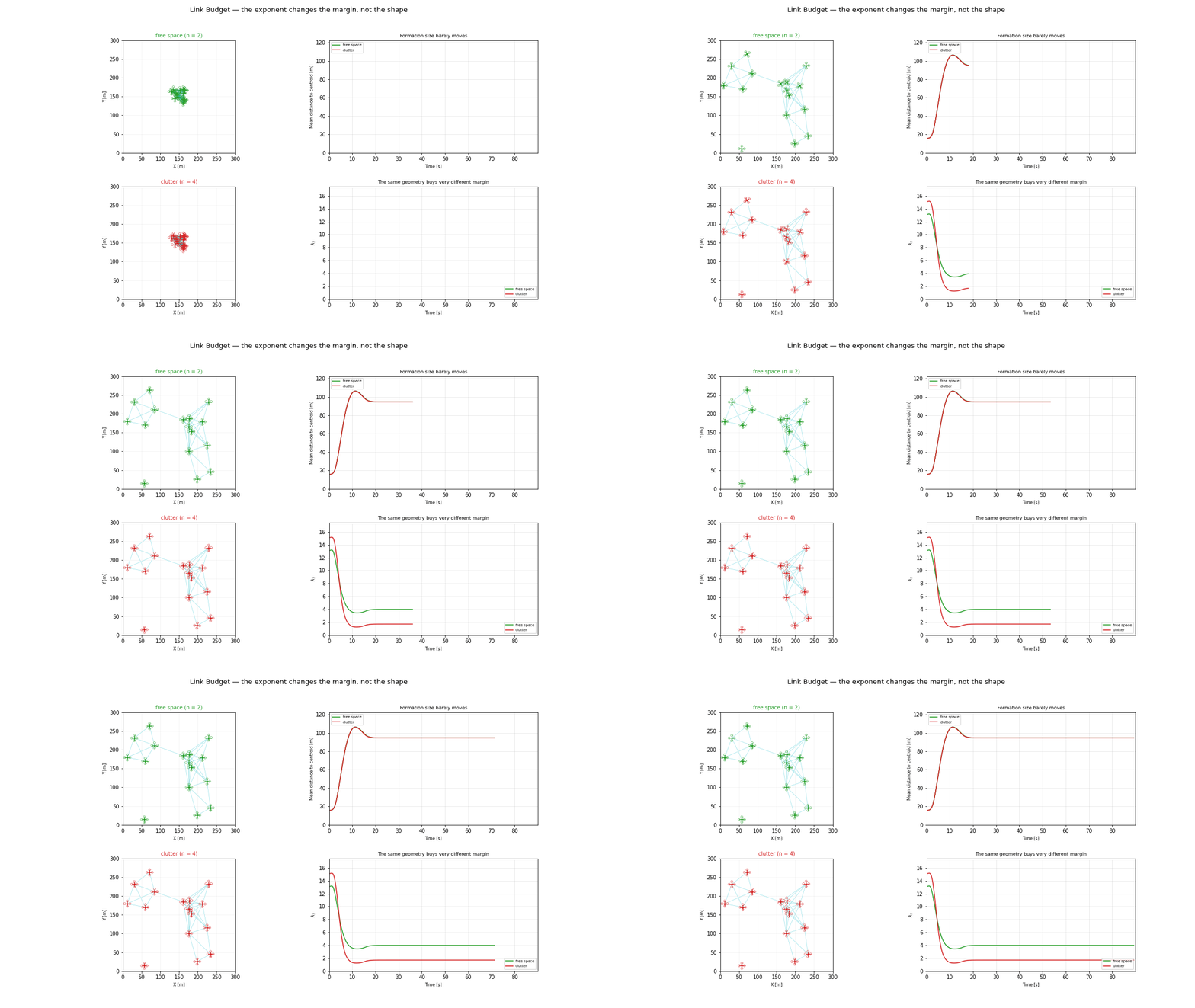
Same fleet, same controller, same gains. Only the path-loss exponent changes:
A negative result
This simulation was built to show that a fleet tuned on a free-space assumption fragments when flown somewhere cluttered. It does not, and the negative result is the more useful one.
| configuration | λ₂ |
|---|---|
| matched clutter (n=4 tuned, n=4 flown) | 1.562 |
| mismatched (n=2 tuned, n=4 flown) | 1.557 |
A difference of a third of a percent. The connectivity gradient is dominated by geometry, not by the exponent: both models are smooth and monotone in range, so they rank the links in the same order and push in nearly the same direction. The exponent changes the magnitudes, and the barrier potential on λ₂ renormalises most of that away.
Getting the link model wrong costs surprisingly little — worth knowing before spending effort characterising a radio to three decimal places.
What the exponent does change
| spread | λ₂ | |
|---|---|---|
| free space | 94.7 m | 3.98 |
| clutter | 94.6 m | 1.71 |
Identical formation, less than half the connectivity. A margin computed in one world does not transfer to the other, even though the control does.
Evidence
References
- A. Goldsmith, Wireless Communications, Cambridge, 2005, ch. 2