
Virtual Structure Formation
Problem Statement
Virtual-structure control treats the swarm as one rigid body with assigned slots for each agent. It enables precise geometric formations during coordinated maneuvers.
Model and Formulation
Each agent tracks:
where p_{vs}, R_{vs} define the structure pose and r_i is agent slot offset.
Practical Notes
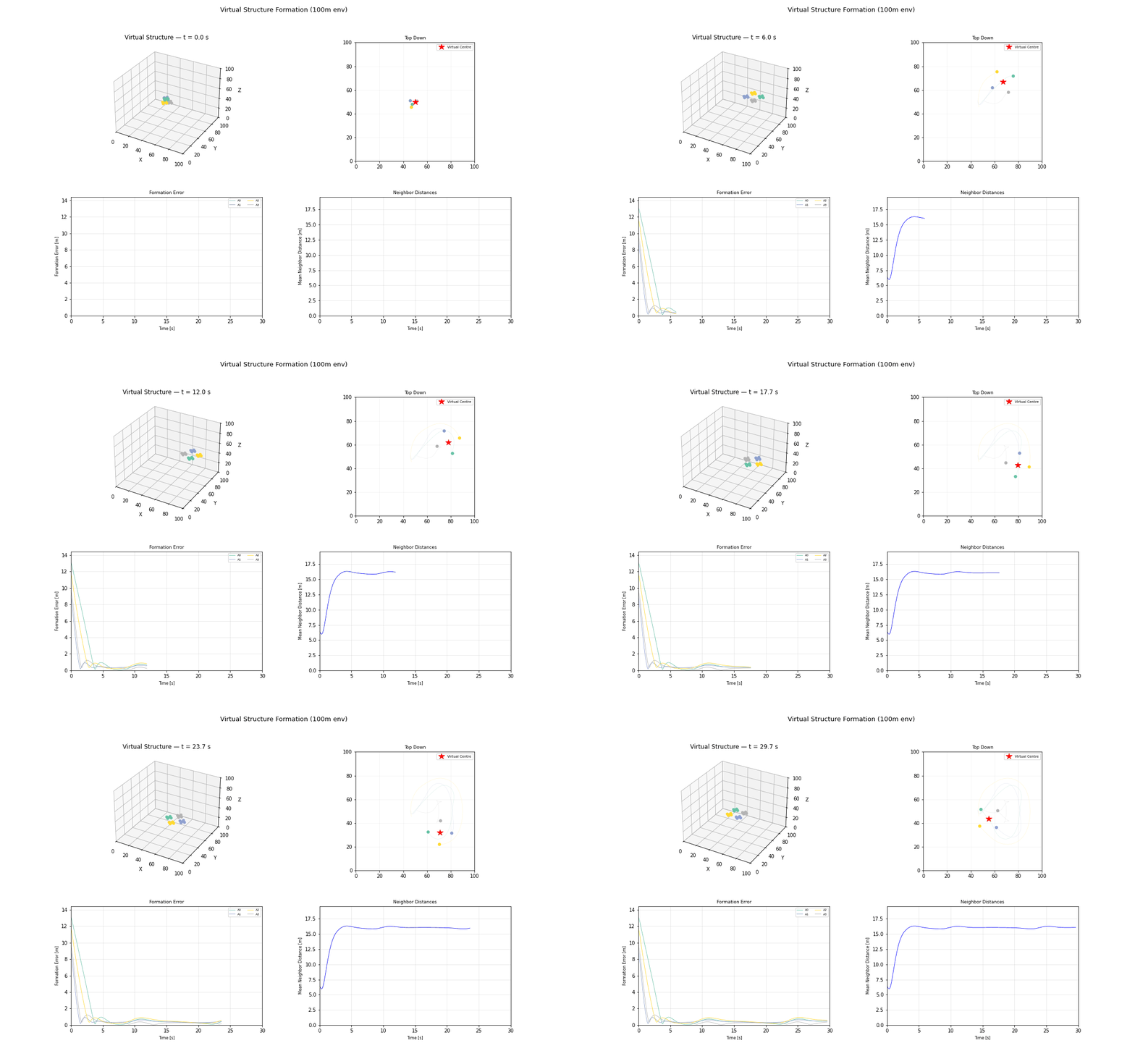
Feed the slot velocity forward, not just its position. Damping against the world frame instead of against the moving slot leaves a standing formation error of
k_d·v_body / k_p— proportional to how fast the structure travels, and easy to mistake for a gain that needs raising. With the feed-forward wired up, formation error on the atlas demo drops from 2.11 m to 0.16 m.For a rotating structure the slot velocity includes the tangential
ω × rterm, and the slot acceleration the centripetalω × (ω × r). A rigid body that yaws with its path needs both.Do not stack a multiplicative velocity decay on top of the PD's own
k_d. The decay behaves as unmodelled drag: it demands a steady force to hold a steady velocity, which the PD can only produce from standing error. The agent model here is a plain double integrator.Works best with reliable relative localization.
Slot assignment should minimize crossing paths during reconfiguration.
Tracking gains should account for heterogeneous agent dynamics.
Implementation and Execution
python -m flybots.simulations.swarm.virtual_structureEvidence
References
- Lewis and Tan, High Precision Formation Control Using Virtual Structures (1997)
- Beard et al., Coordination Variables and Consensus Building in Multiple Vehicle Systems