
Connectivity Maintenance
Problem Statement
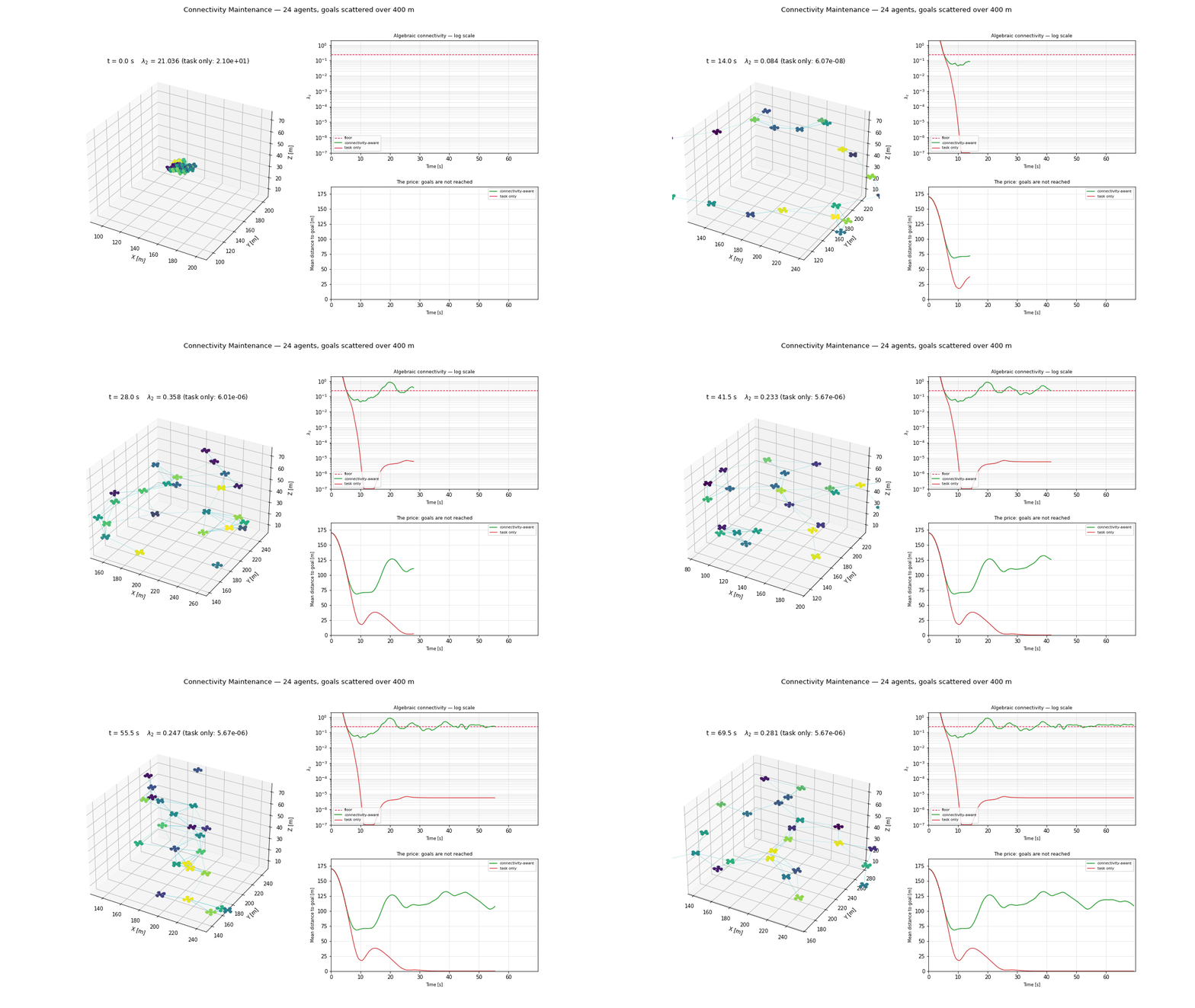
24 agents are each given a goal drawn at random across a 400 m box. Flown straight, the task tears the radio network into islands. The question is whether the fleet can be made to treat its own connectivity as something worth spending goal progress on.
Model and Formulation
The network is a weighted graph, the weight falling smoothly with range. Its health is
The gradient with respect to position has a closed form through the Fiedler vector
Read that for what it says: effort goes where the Fiedler vector disagrees most, not where the distance is greatest. The Fiedler vector is near-constant within a tightly connected cluster and jumps across the weak cut between clusters, so the gradient concentrates on the links actually holding the network together and ignores redundant ones inside a clump.
The controller scales that gradient by a barrier potential in
Tuning and Failure Modes
- A fixed connectivity gain distorts the task everywhere. Tuned for the worst case, it drags on the fleet even when the network is comfortable. The barrier form only overrides the task when the mesh is actually at risk.
- Saturate the force. The barrier diverges by construction; without a limit it produces commands no aircraft can fly.
- A perfectly symmetric formation can produce a repeated
, where the eigenvector — and so the gradient — is not unique. Any disturbance breaks it, but it is why a connectivity controller can look briefly erratic in a regular lattice. - Watch the topology, not just the number. A high
in a chain is still a chain: -connectivity of 1 means every agent is a single point of failure.
Implementation and Execution
python -m flybots.simulations.comms.connectivity_maintenanceEvidence
| run | final | |
|---|---|---|
| task only | 5.67e-06 | 0 (fragmented) |
| connectivity-aware | 0.2762 | 1 |
The aware run does not reach its goals — mean goal error plateaus near 110 m while the task-only run drives it to zero. Connectivity was bought with mission progress, and the second panel shows the bill.
References
- Sabattini et al., Decentralized connectivity maintenance (2013)
- De Gennaro and Jadbabaie, Decentralized Control of Connectivity (2006)
- Optimal Multi-Robot Communication-Aware Trajectory Planning by Constraining the Fiedler Value (2024)